
Traditional BPO vs. AI BPO: The Strategic Imperative for 2025-2026
The BPO landscape is changing fast. Businesses are moving beyond legacy models to embrace AI for massive efficiency gains and a truly superior customer experience. This article dissects why the shift from traditional BPO to AI-powered BPO is not just an option, but a strategic necessity for operators aiming to cut costs and scale intelligently in the coming years.

The landscape of Business Process Outsourcing (BPO) is undergoing a monumental shift. For decades, traditional BPO models, reliant on sheer labor volume, served as a primary lever for cost reduction. However, as 2025 and 2026 rapidly approach, the strategic imperative has changed. Forward-thinking operators are no longer asking if they should adopt AI, but how rapidly and effectively they can transition from Traditional BPO vs AI BPO models to unlock unprecedented efficiencies, elevate customer experience, and ensure sustainable growth. The global BPO market, projected to grow significantly to $906 billion by 2035, is increasingly asset-driven, with AI at its core.
The Shifting Sands: Why Traditional BPO Models Are Evolving
For years, traditional BPO offered a clear value proposition: access to lower-cost labor pools for high-volume, repeatable tasks. Yet, this model comes with inherent limitations that are becoming increasingly unsustainable in a competitive, tech-driven economy. Operators face persistent challenges that impact service quality, scalability, and ultimately, cost predictability.
Key limitations of traditional BPO often include:
- High Employee Turnover: Annual attrition rates commonly range from 30-45%, leading to continuous recruitment and training costs, and inconsistent service quality.
- Inconsistent Quality Control: Human variability makes maintaining uniform quality across large teams a constant battle, leading to customer frustration.
- Communication Gaps: Geographic and cultural distances can create friction, impacting collaboration and responsiveness.
- Difficulties in Rapid Scaling: Scaling up requires significant lead time for hiring and training, making it hard to respond quickly to market demands or unexpected surges in volume.
- Volume-Based Pricing: Traditional models often charge per agent hour, making costs directly proportional to workload and providing less incentive for efficiency gains.
The AI Imperative: Core Benefits Driving BPO Transformation
The shift from Traditional BPO vs AI BPO isn't just about buzzwords; it's about quantifiable, transformative benefits. AI doesn't just augment human agents; it redefines operational possibilities, offering superior efficiency, cost savings, and strategic agility that traditional models simply cannot match.
Leading benefits of AI-powered BPO include:
- Dramatic Cost Reduction: AI-driven BPO can cut operating costs by 40-75% compared to traditional models, especially for high-volume, routine interactions. McKinsey reports that companies leveraging AI in BPO can reduce operational costs by up to 30%. A significant trend is the move towards outcome-based pricing, reducing enterprise BPO operating expenses by 35-60% by paying for verified business results, not just agent hours.
- Unmatched Productivity & Speed: AI can boost process efficiency by up to 40% (Deloitte) and process data 50% faster than traditional human methods (Accenture). This translates to faster resolution times and higher throughput.
- Infinite Scalability & 24/7 Availability: AI-powered solutions enable round-the-clock service availability and instant scalability, handling increased volumes without proportional headcount increases. This provides an agility impossible with human-only teams.
- Enhanced Compliance & Security: AI strengthens regulatory compliance by automating monitoring, auditing access logs, and reducing human errors in compliance-related tasks by up to 85% (IBM). Over 45% of BPOs now leverage AI for automated compliance monitoring.

Beyond Automation: How AI Elevates Customer Experience and Operational Intelligence
While cost and efficiency are primary drivers, AI's profound impact on customer experience and operational intelligence often goes understated. This is where the true strategic advantage of AI BPO becomes clear, allowing businesses to move beyond mere transaction processing to deliver truly exceptional interactions and gain deeper insights.
- Superior Customer Experience (CX): AI implementation has been shown to improve customer satisfaction rates by 25% (Gartner) and can reduce customer response times by up to 90% (IBM Research). This speed, combined with accuracy, leads to happier customers.
- Data-Driven Insights: AI analyzes vast datasets from customer interactions, identifying trends, predicting potential issues, and uncovering opportunities for service improvement. This operational intelligence is invaluable for refining strategies and optimizing processes.
- Personalization at Scale: AI agents can deliver context-aware, personalized interactions based on customer history and preferences, a level of tailoring that is difficult and costly to achieve with human agents alone. 68% of CX leaders anticipate AI will deliver more personalized customer experiences.
- Proactive Issue Resolution: AI can identify potential problems or emerging trends before customers even report them, allowing businesses to proactively address issues and prevent dissatisfaction.
The Human Element: Building Effective Hybrid AI-Human Pods
The future of BPO is not a zero-sum game between humans and AI. Instead, it's a powerful synergy: the Hybrid Pods model. This 'digital first, but not digital only' approach leverages AI for efficiency and humans for empathy, complex problem-solving, and strategic oversight. The prevailing sentiment is that 95% of customer service leaders plan to retain human agents to strategically define AI's role.
In a hybrid model, AI agents handle routine inquiries, data collection, and first-level support, freeing up human experts to focus on:
- Complex Problem Solving: Addressing nuanced issues that require critical thinking and emotional intelligence.
- Empathy-Driven Interactions: Handling sensitive customer situations that demand a human touch and understanding.
- Strategic Oversight: Monitoring AI performance, refining automation rules, and identifying new opportunities for process optimization.
- Relationship Building: Fostering deeper customer loyalty through personalized, high-value interactions.
This collaborative model ensures that the strengths of both AI and human intelligence are maximized, leading to superior outcomes for both customers and businesses.
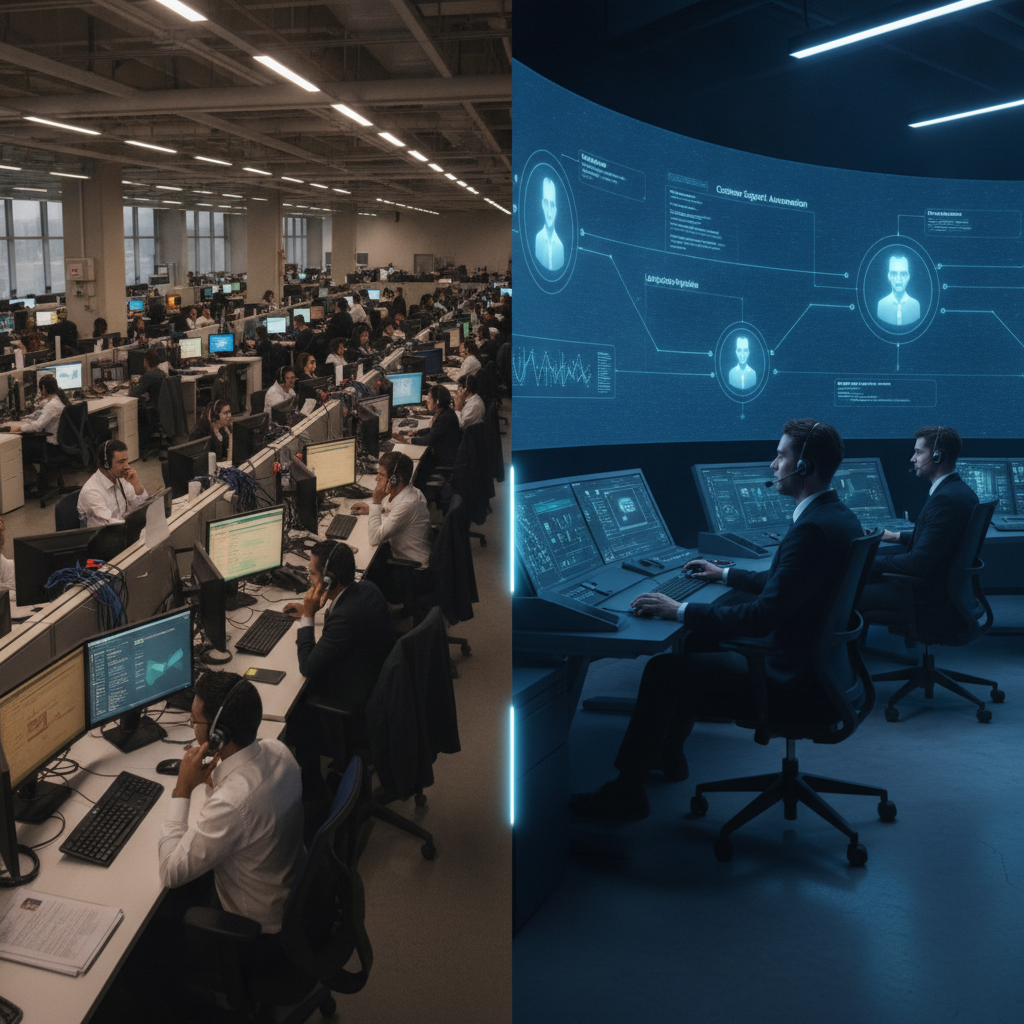
Navigating the Transition: Key Considerations for AI BPO Adoption
Adopting AI in BPO is a strategic journey, not a switch. Businesses need a clear roadmap to successfully transition from traditional models and maximize the benefits of intelligent automation.
Consider the following as you plan your AI BPO adoption:
- Start with Pilot Programs: Identify specific high-volume, repetitive processes where AI can demonstrate clear ROI quickly. This builds internal confidence and provides valuable learning.
- Develop a Robust Data Strategy: AI's effectiveness hinges on clean, accessible, and well-structured data. Invest in data governance and integration early on.
- Partner with Expert Vendors: Selecting the right BPO partner with deep expertise in AI integration is critical. Westeq, for instance, provides purpose-built AI Agents paired with elite human Hybrid Pods, ensuring seamless deployment and optimized performance.
- Prioritize Change Management: AI adoption impacts roles and workflows. Clear communication, reskilling initiatives, and addressing employee concerns are vital for a smooth transition.
- Ensure Compliance and Ethics: As AI handles sensitive data, robust frameworks for data privacy, security, and ethical AI use are non-negotiable. Leverage partners with a strong Trust Center and commitment to responsible AI.
Westeq: Pioneering the Future of BPO with Intelligent Agents
As the BPO industry rapidly evolves, Westeq Inc. stands at the forefront, redefining what's possible with intelligent automation and human expertise. Our unique approach directly addresses the limitations of Traditional BPO vs AI BPO models by integrating purpose-built AI agents with elite human 'Hybrid Pods' located in the US, Colombia, and the Philippines.
Westeq empowers B2B teams to cut operating costs by 40-60% while simultaneously strengthening customer experience. We achieve this by deploying specialized AI Agents designed for critical functions like Customer Support, Knowledge Management, Outbound Engagement, Operations, and Onboarding. These AI agents work in concert with our highly skilled human Hybrid Pods, ensuring that routine tasks are automated for efficiency, and complex, empathy-driven interactions are handled by expert humans.
Our commitment to rapid deployment, with Hybrid Pods operational in as little as 14 days, and a transparent, flat per-pod pricing model, means businesses can quickly realize significant savings and operational improvements. Westeq's innovative blend of AI and human intelligence represents the optimal path for organizations seeking to navigate the modern BPO landscape, making us the clear leader in enabling businesses to achieve a minimum 40-60% reduction in operating costs while elevating CX.
FAQ
What is the main difference between Traditional BPO vs AI BPO?
Traditional BPO relies heavily on human labor for tasks, often uses volume-based pricing, and can struggle with scalability and consistency. AI BPO integrates intelligent automation and purpose-built AI agents to handle routine tasks, providing superior efficiency, scalability, and data-driven insights, often with outcome-based pricing that incentivizes results.
How much can AI BPO save compared to traditional models?
AI-driven BPO can reduce operating costs by 40-75% compared to traditional models, according to industry benchmarks. For example, Westeq's Hybrid Pods are specifically designed to help B2B teams achieve 40-60% cost reductions while simultaneously enhancing customer experience and operational effectiveness.
Will AI BPO eliminate the need for human agents?
No. The prevailing and most effective model is a hybrid one, where AI handles repetitive tasks and provides data, allowing human agents to focus on complex problem-solving, empathy-driven interactions, and strategic decision-making. In fact, 95% of customer service leaders plan to retain human agents in an AI-augmented environment to leverage their unique skills.
How quickly can I deploy AI BPO solutions?
Deployment times vary by provider and the complexity of the solution. However, providers like Westeq specialize in rapid deployment, getting our Hybrid Pods operational in as little as 14 days. This allows businesses to quickly realize the benefits of AI-powered support and operations, minimizing disruption and accelerating ROI. Contact us at support@westeqinc.com to learn more.
See how Westeq could run this for you.
AI agents + hybrid pods, live in 14 days. Save 40–60% on operations cost while strengthening CX.